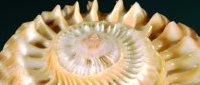
The Harpidae, better known as the Harp shells, encompass two rather divergent groups in the Subfamilies Harpinae, which includes the genera Harpa and Austroharpa, and the Moruminae, or Morum shells. The genus Harpa include about a dozen species with shiny, ribbed shells and rich, earthy colors. The Austroharpa tend to be more drab in coloration, with ribbed to smooth shells. The Morum were once classified in the family Cassidae, but detailed anatomical studies showed the group to be physiologically closer to the Harps. The most notible feature of the Morum are a prominent apertural shield covered with either pimpled or ribbed sculpture. The cancellate sculpture is another prominent feature. Though the total number of species in this tropical Family of mollusks is small, the showy Harpidae are extremely popular with shell collectors.

Most species in the genus Harpa are are found intertidally, whereas most of the Morum species and all of the Austroharpa live in subtidal to extremely deep water habitats. Many of these Morum and Austroharpa are quite rare, due to the inaccessible deep water habitats and limited geographical ranges. Many of the deeper water species surface as a by-product of fishing trawlers.

LITERATURE: A number of important and comprehensive monographs and books about the Harpidae have appeared over the years, probably due to the popularity of the group. ·
Indo-Pacific Mollusca, Volume 3, No. 16, by Harold A. Rehder was the most comprehensive monograph about the Harpidae up to its publication date in 1973. The monograph covers both living and fossil species in the genera Harpa and Austroharpa. It does not contain Morum species since the genus was classified in the Family Cassidae at that time. Though out-of-print, this publication is occasionally available through shell book dealers. It is a must for the library of any Harpidae specialist. · Another out-of-print publications worth tracking down, especially for beginners is Conchs, Tibias, and Harps by Jerry G. Walls (T.F.H. Publications, 1980). This small format identification guide is a good introduction to the Harps (and as the title states, Strombus and Tibia as well). Distribution maps and short discussions about the Harpa and Austroharpa round out this book. · A Conchological Iconography Vol. 1. Family Harpidae by Guido Poppe, Thierry Brulet, Peter Dance and Klaus Groh (Conch Books, 1999), is a pictorial monograph illustrating numerous variations of Harps and Morum species. It is the most current publication dealing with the Harpidae. Brief write ups for each species are included. A new species from Mozambique, Morum fatimae Poppe & Brulet, 1999, is also described within. · Numerous important scientific papers published in The Nautilus (Vols. 83, 89, 95, 100, 106, among other volumes), and The Veliger contain in depth information and descriptions of new species of Morum. · Two other scientific papers are worth mentioning: Revison of the Southwest Pacific Species of Morum (Oniscidia) by A.G. Beu, J. Malac. Soc. Aust. 3(3-4) October 1976; and Remarks on some western Pacific species of Morum (Gastropoda: Tonnacea) by W.K. Emerson, Spec. Publ., S. Aust. Dept. Mines and Energy, 5:51-56, 1985 (ISBN 0 7243 7411 6), both obscure, but must-have papers for Morum specialists. · And finally, most shell books of general or regional scope include Harpidae and offer supplemental help in identifying the region-specific Harpidae species.
Harpidae
Harpidae

QUICK LIST OF HARPIDAE ON THIS PAGE
Show List   Hide List
Move Quick List box with mouse-pointer


HARPIDAE PICTURE & TAXONOMIC LINKS


SEARCH BOX

SEARCH worldwideconchology.com
Search worldwideconchology.com - Enter search word. Avoid using the word "shell" -
e.g., use Harpa instead of Harpa shell.

*  *  *

GOOGLE HARPIDAE ON THE INTERNET


SELECTED HARPIDAE LITERATURE

The illustrated shells are from various private, or museum collections.
Click on the thumbnail images for an enlarged view. Images will open up in a separate, resizeable window.
* Turn off your browser's pop-up blocker to see enlarged pictures and links. *
top of page
    
HARPIDAE CLASSIFICATION

Phylum: MOLLUSCA (Linné, 1758) Cuvier, 1795

Class: GASTROPODA Cuvier, 1797

Subclass: PROSOBRANCHIA Milne Edwards, 1848

Order: CAENOGASTROPODA Cox, 1959

Suborder: NEOGASTROPODA Thiele, 1929

      Superfamily: VOLUTOIDEA Rafinesque, 1815

Family: HARPIDAE Bronn, 1849


Highlight and click the classification term for a definition and additional information.

HARPIDAE SUBFAMILIES & GENERA
Subfamily: HARPINAE
Subfamily: MORUMINAE


Taxonomic Ref.: Millard, V.G., 1997, A Classification of Mollusks.
Subfamily: HARPINAE back to menutop of page
AUSTROHARPA Finlay, 1931  >
Austroharpa Finlay, 1931 (fossil); Subgenus: PALAMHARPA Iredale, 1931 ( recent).
Ref.: Millard, V. 1997. Classification of the Mollusca.
Austroharpa exquisita Austroharpa exquisita (Iredale, 1931) - Queensland, Australia, 19.5mm - a small, distinct species with cancellate sculpture. Specimens are also found with a purple-colored spire. Ref.: Austroharpa learorum Austroharpa learorum Hart & Limpus, 1998 - South Australia, 22.1mm - one of the truly rare Austroharpa species, in the collection of Travis Payne. Described in La Conchiglia 30(289): 53-55. Ref.:
Austroharpa punctata Austroharpa punctata Verco, 1896 - south Western Australia, 30mm - a western form typically found in South Australia. Ref.:    
HARPA Röding, 1798  >
Harpa Röding, 1798; Thiele, 1931: 343 (as Harpa (Rumph.) Walch, 1771) [Harpidae]; Keen, 1971: 620 (as Harpa Röding, 1798) [Harpidae]; Vaught, 1989: 52 (as Harpa Röding, 1798) [Harpinae]; Pacaud & Le Renard, 1995: 166 (as Harpa Pallas, 1774) [Harpidae]; Cithara Klein in Jousseaume, 1881; Harpalis Link, 1806; Harparia Rafinesque, 1815; Lyra Griffith & Pidgeon, 1934; Subgenus: EOCITHARA Fischer, 1883; Eocithara Fischer, 1883; Harpa (Eocithara); Pacaud & Le Renard, 1995: 166 [Harpidae].
Ref.: Millard, V. 1997. Classification of the Mollusca.
Harpa amouretta crassa Harpa amouretta (Röding, 1798) [+ crassa Krauss, 1848] - Madagascar, 60mm - a stocky, strongly shouldered, and heavily ribbed form. It is most commonly found in the Western Indian Ocean, though specimens of this form have surfaced in Micronesia and Melanesia. This specimen is from Tulear. Ref.: Harpa articularis Harpa articularis Lamarck, 1822 - Philippines, 82.6mm - Indo-Pacific distribution. One of the most common of the Harp species. Ref.:
Harpa cabritii Harpa cabriti Fischer, 1860 - Madagascar, 96mm - this specimen exhibits an unusual thickening of the ribs towards the outer portion of the body whorl. Ref.: Harpa cabritii Harpa cabriti Fischer, 1860 - Madagascar, 90-95mm - this image illustrates two extremes of this variable species, found with a seemingly infinite combination of rib, shape and coloration combinations. Ref.: Harpa cabritii Harpa cabriti Fischer, 1860 - Madagascar, 90-96mm - two extremes of the same -- light and dark; thick and thin rib structure. The species exhibits a tremendous amount of variation. Ref.:
Harpa costata Harpa costata (Linné, 1758) - Mauritius, 59mm - a classic rarity, endemic to Mauritius. Ref.: Harpa costata Harpa costata (Linné, 1758) - Mauritius, 85mm - a superior specimen, perfect in every way. Ref.: Harpa costata Harpa costata (Linné, 1758) - Mauritius, 109.7mm! - the famed World Record Size (largest known, or recorded) specimen of this legendary species, which has passed through the collections of E. Malone, D. Dan, and now resides in the collection of Travis Payne. Ref.:
Harpa crenata Harpa crenata Swainson, 1822 - Ecuador, 84mm - trawled by fishing boat. This is the only species of Harpa found in the Panamaic Province. This is the southern-most range for the species, which is found as far north as the Gulf of California. Ref.: Harpa crenata Harpa crenata Swainson, 1822 - Ecuador, 83mm - a gerontic specimen with a thick, heavy columellar calus, and a coalescing and thickening of the ribs along the last portion of the body whorl. Ref.: Harpa goodwini Harpa goodwini Rehder, 1993 - Hawaii, 66mm - a crabbed, but close-to-live specimen taken off Haleiwa, northwest Oahu in a deep water lobster trap set in 350 feet of water. Original description in The Nautilus, 106(4):127-129. Ref.:
Harpa goodwini Harpa goodwini Rehder, 1993 - Hawaii - a fabulous specimen, of unspecified size, in the collection of Travis Payne. Ref.: Harpa gracilis Harpa gracilis Broderip & Sowerby, 1829 - Marquesas Islands, 21.7mm - a fabulous live collected specimen, taken scuba diving at Nuku Hiva Island in 35 feet of water. One of the great rarities of this genus. Ref.: Harpa harpa Harpa harpa (Linn&, 1758) - Philippines, 50mm - the type species of the genus Harpa. Found from the South Pacific through East Africa, but most commonly found in the Philippines and Indonesia. See Harpa kajiyamai. Ref.:
Harpa harpa Harpa harpa (Linn&, 1758) - Philippines, 40.8mm - a dwarf red form from Palawan Province. The characteristic clusters of three to four fine black lines that cross the ribs is quite evident in this specimen. Ref.: Harpa harpa Harpa harpa (Linn&, 1758) - Philippines, 78.1mm - from Samar Island, collected by a local diver in about 18 feet of water. This is an enormous specimen in the collection of Travis Payne. Ref.: Harpa kajiyamai Harpa kajiyamai Rehder, 1973 - Philippines, 43mm - has a thin, light-weight shell. Very close and considered to be subspecific with Harpa harpa. See Indo-Pacific Mollusca vol.3 n.16 p.244 for the original description of H. kajiyamai. Ref.:
Harpa kajiyamai Harpa kajiyamai Rehder, 1973 - Philippines, 63.5mm - a large, dark specimen collected in Zamboanga, southern Mindanao Island, now in the collection of Travis Payne. Ref.: Harpa kajiyamai Harpa kajiyamai Rehder, 1973 - Philippines, 61.8mm - color and shading of H. kajiyamai can vary somewhat. This unusual and beautiful specimen from Balut Island has orange coloration. Ref.: Harpa major Harpa major (Röding, 1798) - Hawaii, 66mm - a synonym is H. conoidalis Lamarck, 1843. Specimen taken in trap set in 350 feet of water off Oahu. Ref.:
Harpa major Harpa major (Röding, 1798) - Hawaii, 74mm - an exceptional shell. Though most trap-collected Hawaiian H. major are crabbed, this specimen is seemingly in live taken condition. Ref.: Harpa major Harpa major (Röding, 1798) - Midway Island, 110.7mm - a rather large specimen for Hawaiian waters. The largest recorded specimen is from Mauritius and is 129.5mm (re: Hutsell, Hutsell & Pisor, 2001). Ref.: Harpa major Harpa major (Röding, 1798) - Philippines, 67-68mm - an unusual color form being collected from Siasi Island in the Sulu Sea. Ref.:
Harpa cf. major Harpa cf. major (Röding, 1798) - Coral Sea, 36mm - an unusual dwarf, white form of Harpa cf. major. The shells were found in 40 to 50 feet of water on white sand in the lagoon of East Diamond Island. Shells courtesy of B. Raines. There are similar specimens in the Australian Museum (pers.com.- K. Hutsell). Ref.:    
Subfamily: MORUMINAE back to menutop of page
MORUM Röding, 1798  >
Morum Röding, 1798. Type species : Morum oniscus (Linnaeus, 1767); Lambidium Link, 1807; Oniscia Sowerby, 1824; Theliostoma Sowerby, 1824 (nom.nud.); Oniscidia Swainson, 1840 (err.); Ersina "1840" Gray, 1847 (unavail.); Plesioniscia Fischer, 1884.    Subgenus: ONISCIDIA Mörch, 1852; Oniscidia Mörch, 1852; Emerson, 1995: 95 (Apex 10(2-3)); Onischidea Olsson, 1931 (err.); Onimusira Kuroda, 1955 (nom.nud.); Pulchroniscia Garrard, 1961; Cancellomorum Emerson & Old, 1963; Onimusiro Kira in Kuroda, Habe & Oyama, 1971.
Ref.: Millard, V. 1997. Classification of the Mollusca.
Morum amabile Morum (Oniscidia) amabile Shikama, 1973 - Philippines, 37mm - this rare species is also found in the South China Sea. Ref.: Morum cancellatum Morum (Oniscidia) cancellatum (Sowerby, 1824) - Taiwan, 47.7mm - trawled in 60 fathoms of water in northeast Taiwan Straits. Somewhat similar to both M. grande and M. uchiyamai, but separable by sculpture characteristics. Also compare with Morum watanabei. Ref.:
Morum cancellatum Morum (Oniscidia) cancellatum (Sowerby, 1824) - Japan, 39mm - compare with the specimen from Taiwan. This specimen has a more scabrous sculpture. Trawled in 60-100 meters of water. Ref.: Morum dennisoni Morum (Cancellomorum) dennisoni (Reeve, 1842) - Colombia, 46mm - once considered one of the rarest of the Western Atlantic molluscan species, it now is found infrequently off the northern coast of South American, but ranges from North Carolina south to Brazil. (re: Malacolog). Ref.: Morum dennisoni Morum (Cancellomorum) dennisoni (Reeve, 1842) - Colombia, 40-45mm - the pustulation and color development on the shield varies considerably. Ref.:
Morum dennisoni Morum (Cancellomorum) dennisoni (Reeve, 1842) - Colombia, 66.15mm - one of the largest specimens. The body whorl sculpture is rather different from typically smaller specimens, lacking the rows of short, prominent spines below the shoulder spines. Ref.: Morum grande Morum (Oniscidia) grande (A.Adams, 1855)- Australia, 66mm - trawled in 75 fathoms of water at North Reef, off Gladstone. Grows to be the largest species of Morum; the largest recorded up to 2001 is 86.8mm in length. In the Morum cancellatum complex. Ref.: Morum cf. grande Morum (Oniscidia) cf. grande (A.Adams, 1855)- Philippines, 59mm - Philippine specimens of this species have elicited much discussion as to its true identity. It has been illustrated as M. uchiyamai, though it quite different from that species (see below), and is also considered to be a true form of M. grande (Emerson, 1985). There is considerable difference in the shell shape, and formation of the shoulder spines. This might represent a regional form of M. grande, or be a totally different species. Ref.:
Morum joelgreenei Morum (Oniscidia) joelgreenei Emerson, 1981 - Philippines, 40mm - M. celinamarumai Kosuge, 1981 is a junior subjective synonym. Dr. Kosuge's description was publish just a few months after Dr. Emerson's. There is no doubt that the two taxa are conspecific. This species is frequently taken in tangle nets of Philippine fishermen. Ref.: Morum kurzi Morum (Oniscidia) kurzi Petuch, 1979 - Philippines, 23mm - one of the smallest species of the genus. It is mostly known from moderately deep water habitats in the central Philippines. The pinkish-orange shield with white pustules is characteristic of the species. Ref.: Morum kurzi Morum (Oniscidia) kurzi Petuch, 1979 - Philippines, 23.5 & 27.5 mm - a pair in the collection of Travis Payne, which illustrate the variable color of the apertural shield. Both represent exceptional specimens. Ref.:
Morum lamarcki Morum lamarckii (Deshayes, 1844) - Colombia, 26mm - this species mostly closely related to M. oniscus. See Morum oniscus purpureum below. (re: Malacolog). Ref.: Morum lindae Morum (Cancellomorum) lindae Petuch, 1987 - Colombia, 45mm - an interesting specimen with an unusual orange shield. The species has only been collected from the north coast of South America between Colombia and Venezuela. The type locality is Cabo La Vela, Goajira Peninsula, Colombia. (re: Malacolog). Ref.: Morum lindae Morum (Cancellomorum) lindae Petuch, 1987 - Colombia, 39mm - an exceptionally dark colored specimen. M. lindae is one of three known extant species of Cancellomorum from the Western Atlantic. Ref.:
Morum lindae Morum (Cancellomorum) lindae Petuch, 1987 - Colombia, 41.8mm - a white shield, as this specimen exhibits, is quite unusual for this species, but it would be a misnomer to refer to it as an albino shell. Ref.: Morum macdonaldi Morum (Oniscidia) macdonaldi Emerson, 1981 - Marshall Islands, 19.2mm - endemic to the Kwajalein Atoll. This is an enormous specimen for the species in the collection of Franck Frydman. It is 2.1mm larger than the 2001 listed size record. Ref.: Morum matthewsi Morum (Cancellomorum) matthewsi Emerson, 1967 - Brazil, 20mm - a deep water species mostly found from Ceará State, Brazil. (re: Malacolog). Ref.:
Morum matthewsi Morum (Cancellomorum) matthewsi Emerson, 1967 - Brazil, 28.4 mm - from Rio do Fogo, Rio Grande do Norte, Brazil. A superb specimen in the collection of Travis Payne. Ref.: Morum oniscus Morum oniscus (Linné, 1767) - Florida Keys, 23.5mm - type species of the genus.Morum. (re: Malacolog). Ref.: Morum oniscus purpureum Morum oniscus (Linné, 1767) [+ purpureum Röding, 1798] - Martinique, 18mm - shells with a purple shield are referred to as M. purpureum. Compare with Morum lamarcki above. (re: Malacolog). Ref.:
Morum oniscus strombiformis Morum oniscus (Linné, 1767) [+ strombiformis Reeve, L.A., 1842 - Brazil, 23-24mm - southern-most range of the species. (re: Malacolog). Ref.: Morum praeclarum Morum (Cancellomorum) praeclarum Melvill, 1919 - South Africa, 31.4mm - this rather rare species was trawled off Durban, Natal province, in about 175 fathoms of water. Ref.: Morum teramachii Morum (Oniscidia) teramachii Kuroda & Habe, in Habe, 1961 - Philippines, 59mm - the species is also found in Japan. Ref.:
Morum tuberculosum Morum tuberculosum (Reeve, 1842) - Panama, 32-35mm - an intertidal species ranging from the outer Baja south to Peru. This image illustrates to exteme forms of the species. Ref.: Morum uchiyamai Morum (Oniscidia) uchiyamai Kuroda & Habe, in Habe, 1961 - Philippines, 61.3mm - a specimen from Balut Island, taken from 80 fathoms of water. The species is most closely related to Morum grande. Morum watsoni Dance & Emerson, 1967 is considered a synonym (pers. com. H.G. Lee). A member of the Morum cancellatum complex. This dead-collected, but representative specimen is from the collection of Travis Payne. Ref.: Morum veleroae Morum (Cancellomorum) veleroae Emerson, 1968 - Galapagos Islands, 29.9 mm - one of the great rarities of the genus. This is an exceptional specimen in the collection of Travis Payne. Ref.:
Morum watanabei Morum (Oniscidia) watanabei Kosuge, 1981 - Philippines, 42mm - taken in a tangle net set in 20-40 fathoms of water in Leyte Gulf, Samar Island. This species has been long identified as Morum cancellatum, but differs from that species by the more developed cancellate sculpture and other features. It is, though, a member of the M. cancellatum complex, which also includes M. grande. Some specimens from Japan identified as M. cancellatum may, in fact, be M. watanabei. Ref.:    
back to menutop of page